Thursday, November 18, 2010

Bunker on #2

On Wednesday November 17, 2010 we removed the bunker that was positioned just off the right front corner of #2 green.  The removal of this bunker is called for in our Long Range Plan, and was a project that we could undertake without a large capital expenditure.  It basically cost us just the manpower to do it.

As you know, this bunker is one of a few on the course that were repeatedly made unplayable by any heavy rainfall.   While it is not as big a problem as say the right bunker on #1, or the bunkers in front of #3 or #10, it was a situation that we could remedy quickly and without a large expenditure, so we were able to do it at this time.  We are hoping to do something similar to the back bunker on #10, and eventually the back bunker on #1.  All three of these are targeted for removal by our Long Range Plan.  (click pictures to see full size)


Above is a picture taken the day before demo / reconstruction began.


The picture above shows the same basic area after it has been filled and reshaped.  It has not yet been seeded or sodded, but will be very shortly.

Here is another view of the area, showing that the entire area was resculpted so that it won't just look like we filled in a bunker.  The mounding around the bunker was smoothed to blend with the existing terrain.

And finally, this view looking back toward #2 tee demonstrates that the revised area is not just going to be a grass bunker, but was reshaped to blend with the existing terrain.  You can also see a bit in this picture that the mounding on the left (as you view this image) is angled so that a ball hit that far right will have a chance to kick either straight forward, or maybe even back toward the green a bit.

Monday, July 26, 2010

CICADA KILLERS

It's that time of year again. The Cicada Killer wasps are back. Here's a little info about these guys (and gals) and what they are all about.

You've probably seen these buzzing around before, especially around sand traps and putting greens.  They are Eastern Cicada Killer wasps, and as their name implies, they kill cicadas.

Here's a website with more information: LINK

From the website above:
The female cicada killer on the right is carrying a paralyzed annual cicada (Tibicen linnei) back to her burrow, where she will put it in a nest cell, lay an egg on it and seal the cell. A grub will hatch from the egg in a few days, eat the cicada and overwinter underground in a hard cocoon which it weaves. It will pupate in the spring, hatch in July or August, dig its way to the surface and live above ground for 2-6 weeks; all adults die annually. The cicada killer has adapted its life cycle to be in synchrony with that of its hosts: Like the several species of “annual” cicadas with which it feeds its young, a cicada killer spends over 90% of its life underground as a larva. Like most hunting and parasitic wasps, the cicada killer is a beneficial insect; it exerts a measure of biological control on cicadas, some species of which damage deciduous trees by laying eggs under the soft bark of the new growth on the trees’ terminal branches. Because they emerge each year in mid-July, cicada killers are not significant predators of periodical (13- and 17-year) cicadas, which emerge in May and June and die off by mid-July.

Males aggressively defend their perching areas on nesting sites against rival males but they have no sting. Although they appear to attack anything which moves near their territories, male cicada killers are actually investigating anything which might be a female cicada killer ready to mate.   (sound familiar?)  Such close inspection appears to many people to be an attack, but male and female cicada killers don't land on people and attempt to sting. If handled roughly females will sting, and males will jab with a sharp spine on the tip of their abdomen.

For us, the only real problem they cause is the burrowing in our greens and sand bunkers.  They apparently provide a benefit by keeping the cicada population in check, and they don't typically sting humans.  And now you know more about cicada killer wasps than you ever thought you would.  :)

Monday, July 19, 2010

HOT DAYS!

Do you remember in last month's newsletter the comment that Alex made about being more concerned with keeping the greens alive than he is with keeping a certain speed to them? Well, this is the time when that statement really rings true. We've had temperatures in the 90's for about 2 weeks now, and the forecast for this week is pretty much mid-90's all week. This is when the maintenance practices that have been applied to the course really pay dividends.

On these very hot, sunny days, you may notice areas on some of the greens begin to take on a purplish tint. That is a sign of distress. Keep in mind that you are dealing with grass plants that are mowed to .130" each day, so there's not a lot of plant there to hold water and withstand these harsh conditions. But, the healthier we can make that plant, the better suited it is to take the punishment. By growing the greens a little taller this year (.130" instead of .125") we are also giving them more root zone, which typically means a healthier plant, which in turn means it can be more tolerant of the heat. Perhaps they've been a bit slower than in the past, but take a look your next time out at how healthy they are now.

DID YOU KNOW that on these days of extreme heat there is someone assigned each day to monitor the conditions of the greens, even on weekends? Between about noon and 3:00pm are the times that symptoms of distress are most likely to appear. Those will be the times that you will see one of our crew running around the course like a mad man, hooking up a hose and either misting or hosing down individual greens. This isn't done to provide water to the greens, but rather to simply cool them down. Kind of like wiping a cool washcloth across the back of your neck and face. It doesn't provide you with any liquid nourishment, but it sure makes you feel better! If conditions are really extreme, you may see them turn on the irrigation for a couple minutes.

Higher green speeds are partly obtained by shorter mowing heights and reduced moisture content. The faster the greens are, the more stressed they are and the closer they are to being dead. We work hard to achieve a balance between green speed and healthy greens, so that we can provide a quality playing surface without having it in a stressful condition all of the time.

For questions about this or any other course topic, contact Alex, Dennis, or any of your greens committee members.

Sunday, July 18, 2010

HAWKS?


Any birders out there? A pair of these guys have been spending a lot of time this year in the wooded area left of 12 fairway. Their calls sound very similar to samples I've found on-line of red-tailed hawks, but I don't know if others sound similar. This one I'd guess is 12"-15" tall, not counting tail. The next time you play #12 keep your ears sharp for the shrill call. The last time I played one was circling overhead.

I'd love to hear from you if you can positively ID the bird(s). Send me an email dennis@djonesassoc.com.


Monday, July 12, 2010

Storms AGAIN!


It seems like I've posted a lot of stuff about storm damage the past couple years. Sunday afternoon we had a pretty good storm blow through. The good news is that other than our tents we didn't sustain too much damage. All of the tree trimming and thinning that we've done in the past year appears to have helped, as the main thing we saw were lots of leaves and smaller limbs blown about, but no trees down or large limbs. There was one large section of a tree behind #4 tee that fell and blocked the entrance road for a while, but it was quickly moved out of the way.

(thanks to Phil Morgan for this picture)

Our major loss was our two tents. The yellow tent that is normally in the parking lot and used as a concession tent during tournaments was blown down close to #9 green. The red/white tent that is kept on the patio above #18 green was blown up and over the roof of the clubhouse, ending up on the roof above the entrance door to the banquet room. (see the crappy cell phone picture) Those 5-gallon buckets that are used to hold the tent down? They were still attached when it landed on the roof.

All of this happened during the final round of the Ladies Scramble Tournament. We eneded up with at least two weather delays, but the tournament was finally completed late Sunday night. See the Tournaments page for results.

Tuesday, July 6, 2010

July 4th Fireworks


We had a nice turnout and nice fireworks display on Sunday night. The panoramic picture above shows just part of the crowd that was around the clubhouse and first tee area. There were people watching from around the practice green, near 3 green, and all up and down the entrance road. I also understand that the shoulder of Hwy 54 was packed, as well as a large contingent of boats anchored in the main channel. (The picture above was a 9-second exposure. It was really much darker than this when the picture was taken.)

Here are a few samples from Sunday night. (Click any of the pictures for a larger version)

It was a beautiful night to watch the fireworks.


Wednesday, June 16, 2010

16 Fairway Drainage

So, what's going on that 16 fairway has been so wet this year, you ask? Well, part of the problem is that we have had back-to-back years of 60" rain fall, when about 40" is our normal annual average. Our water table is very saturated and there's just not a lot of places for any rainfall to drain off to. But, that isn't really what our main problem has been.

We suspected and have confirmed that water is leaking under the dam of the pond on #14 and making its way to 16 fairway. There is (was!) a spot in 16 fairway where we could actually see water percolating up to the surface. That spot was about three and a half FEET lower than the surface of the pond on 14. Two weeks ago we put blue dye into the pond on 14. Within minutes the water that was surfacing in 16 fairway was blue. Our suspicions were confirmed that the water was leaving the lake UNDER the dam and flooding the fairway.

The only real "right" fix for this is to fix the dam. Our Long Range Plan calls for rebuilding the pond on 14, resizing it to include the drainage that crosses 14 rough to the bridge on 16, and in the process lowers the pond by two feet. That is an expensive fix, and not one that we really want to undertake in the middle of our prime golf season.

As a temporary fix we are taking three actions:
1: Drainage will be installed between the cart path and the pond on #16 to intercept the leakage before it reaches 16 fairway.
2: We have packed mud and muck into the spot on the dam we believed was the source of the leak. This has already shown great results.
3: We will add drainage across 16 fairway to replace existing drainage that is apparently no longer working. This way, if water continues to leak and gets past our new drains it should still be taken off by the new fairway drains.

This is at best a temporary solution. "Temporary" might be 5 or 10 years, or it might all come apart next year - it all depends on how well our patches to the dam hold. But, for now, this should allow us to get 16 fairway dried up, and we think based on the things we saw today that it will dry up rather quickly. This video shows how much water was running in the drainage ditch that we excavated between the cart path and the pond. All of this water was previously making its way to 16 fairway.

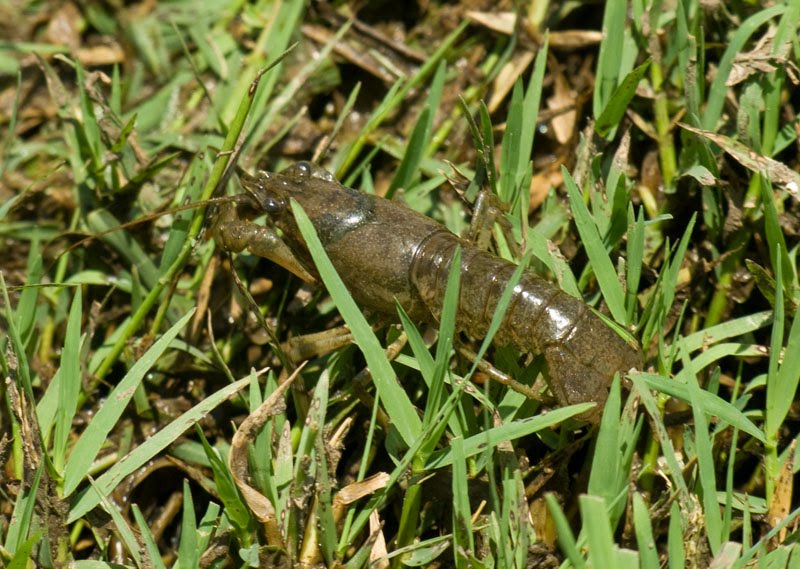
I'm not saying this fairway was wet, but this guy showed up after we got the leak stopped.